How to prevent FOD in Aviation?
FOD prevention in aircraft maintenance depends on disciplined housekeeping, control of parts and consumables, and positive accountability for every tool brought into a controlled work area. RFID supports the tool-control layer of a FOD program; it does not detect or eliminate every form of foreign object debris.
An effective aviation tool-control process should:
Standardize tool ownership and storage: Use controlled tool inventories, designated storage locations and consistent identification rather than unmanaged personal toolboxes.
Record issue, return and movement: Maintain a clear record of which tools were issued, who used them and whether they were returned.
Verify tools before releasing the work area: Confirm that all tools are accounted for at the end of a task, maintenance shift or inspection.
Control the complete tool lifecycle: Connect each tool to its inspection, calibration, repair and replacement records.
Define exceptions and escalation: Establish what happens when a tool is missing, damaged, overdue for calibration or cannot be directly tagged.
These controls can be implemented using visual storage, manual records, barcodes or electronic identification. RFID becomes valuable where aviation MRO teams need faster inventory checks, automated read events or stronger accountability across large tool populations and multiple storage or work areas.
What is Tool Control in Aviation?
Tool control is the set of procedures and systems used to identify, store, issue, return, inspect and account for tools used during aircraft maintenance. Its primary purpose is to reduce the risk that an unaccounted tool remains inside an aircraft or controlled work area.
Aviation tool-control procedures typically cover:
A unique identity and designated storage position for each tool
Tool issue, return and custody records
Inventory checks before and after maintenance work
Escalation and search procedures for missing tools
Inspection, calibration, repair and replacement status
Records supporting internal reviews and external audits
These controls strengthen accountability but cannot eliminate FOD risk by themselves. Their effectiveness depends on consistent procedures, technician compliance and verification before the aircraft or work area is released. Electronic identification can make those controls faster and easier to document, particularly across large tool inventories, multiple shifts and distributed maintenance areas.
FOD Check Systems
Aviation MRO teams typically combine several controls according to the size of the tool inventory, maintenance workflow and level of automation required. Visual storage, manual records, optical identification and RFID are complementary methods rather than universal replacements for one another.
Shadow Tool Boards
Shadow boards assign each tool a visible storage position. A missing tool can be identified quickly when its position is empty, while tool tags, T-cards or manual records can show who removed it.
This method is practical for smaller, centrally managed tool inventories. Its effectiveness depends on visual inspection, consistent tool return and accurate manual records.
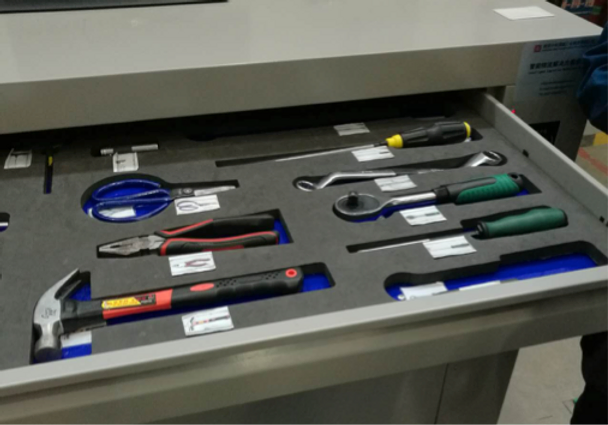
Foam Tool Inserts
Custom-cut foam inserts secure tools inside drawers, cabinets, trolleys and mobile toolkits. Contrasting foam layers make empty positions easier to identify during visual checks.
Foam inserts provide clear storage discipline but confirm only whether the expected position is occupied. Additional identification or records are required to verify the individual tool, user, calibration status or movement history.
Barcodes, QR Codes and Optical Markings
Barcodes, QR codes and laser markings provide item-level identification and can connect tools to digital issue, return, inspection and calibration records.
Their principal limitations are operational:
The identifier must be visible to the scanner.
Tools are normally scanned individually.
Dirt, fluids, abrasion or damage can affect readability.
Results depend on the operator completing each required scan.
These methods may be sufficient for controlled inventories with manageable transaction volumes. RFID becomes relevant when the workflow requires faster bulk inventory, automated read points or identification without direct line of sight.
How RFID Supports FOD Tool Control
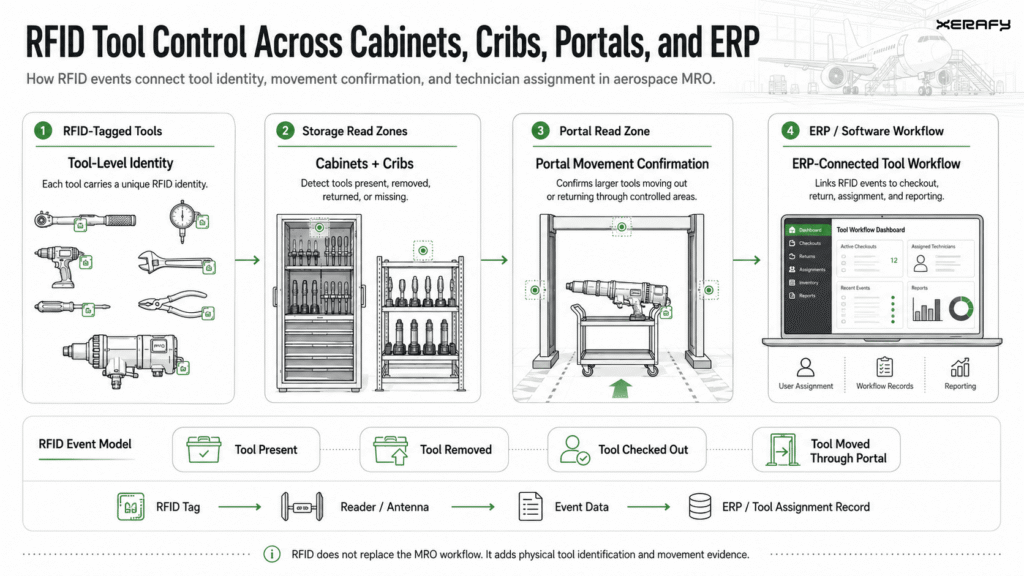
RFID gives each tagged tool a unique machine-readable identity linked to its record in the tool-management or MRO software. When the tool is detected at a defined read point, the system can record its presence, removal, return or movement according to the configured workflow.
Unlike optical identifiers, passive RAIN RFID does not require the tag to be visible to the reader. Multiple tagged tools can also be identified during the same inventory operation.
RFID Tool-Control Read Points
Different maintenance workflows require different read configurations:
Handheld readers support tool inventories and directed searches across cabinets, trolleys, work areas and aircraft maintenance zones.
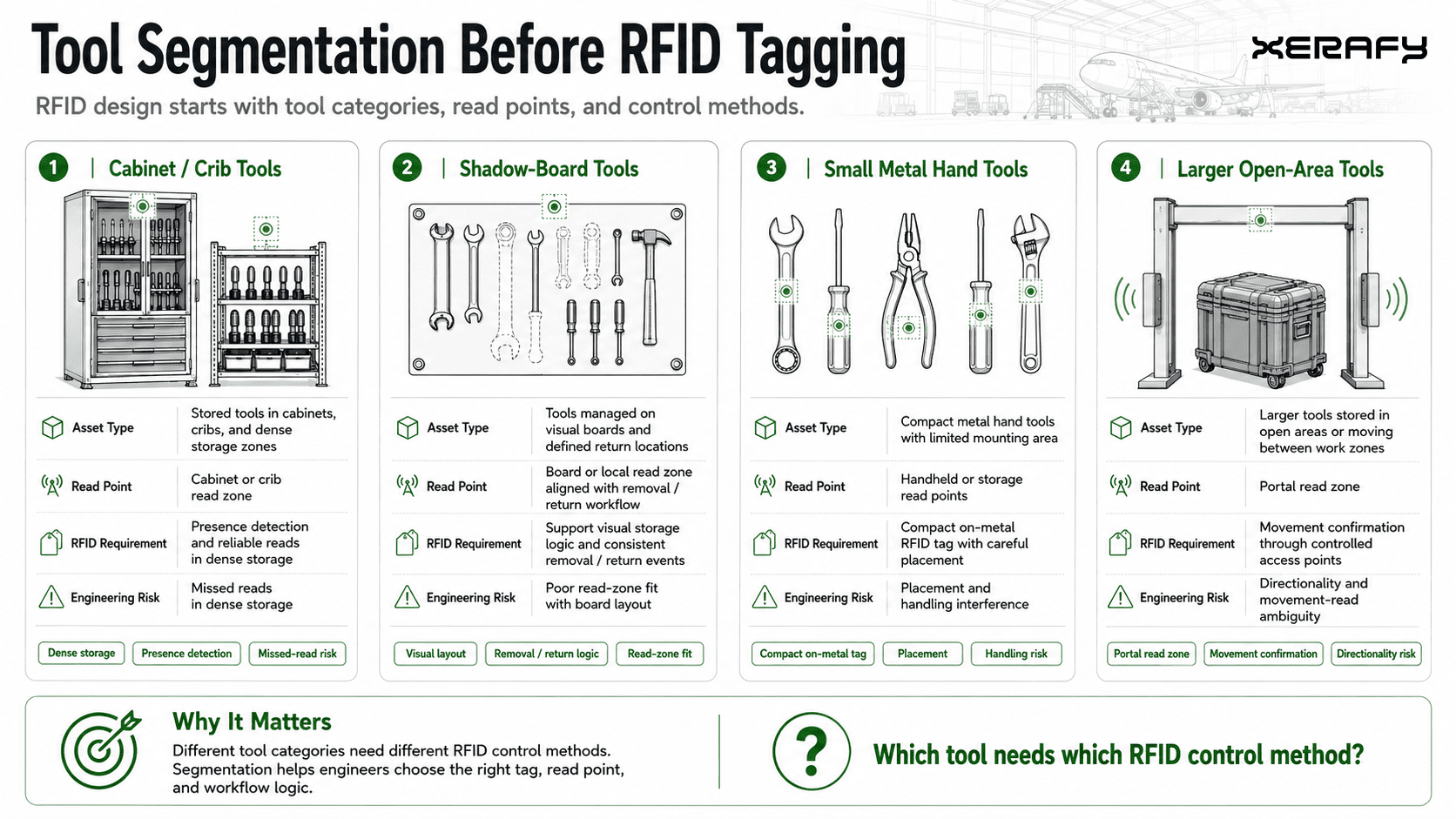
RFID-enabled cabinets, cribs and trolleys detect tagged tools within controlled storage and can generate presence, removal or return events.
Portal and fixed readers capture tagged tools moving through defined access points or between controlled areas.
Kiosks and issue stations connect tool identity to check-in, check-out or technician-assignment workflows.
The reader confirms that a tag was detected at a particular read point. The software determines what that read means for tool status, custody, alerts and reporting.
RFID Compared with Barcodes and Optical Identification
RFID can provide several operational advantages:
Tools can be identified without visually locating and aligning each identifier.
Multiple tagged tools can be read during an inventory operation.
Fixed readers can capture events without requiring a technician to scan every tool manually.
Tags can be attached or embedded in positions that protect the identifier from dirt, fluids and repeated handling.
These advantages depend on tag selection, placement, attachment, surrounding metal, reader configuration and storage density. No RFID tag should be assumed to read in every orientation or through every container. Candidate configurations must be tested on representative tools in the intended cabinet, crib, trolley, portal or handheld workflow.
Tagging Legacy and Small Tools
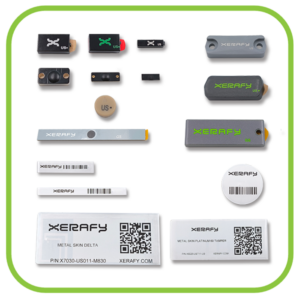
Most legacy tool inventories can be segmented into repeatable tagging configurations:
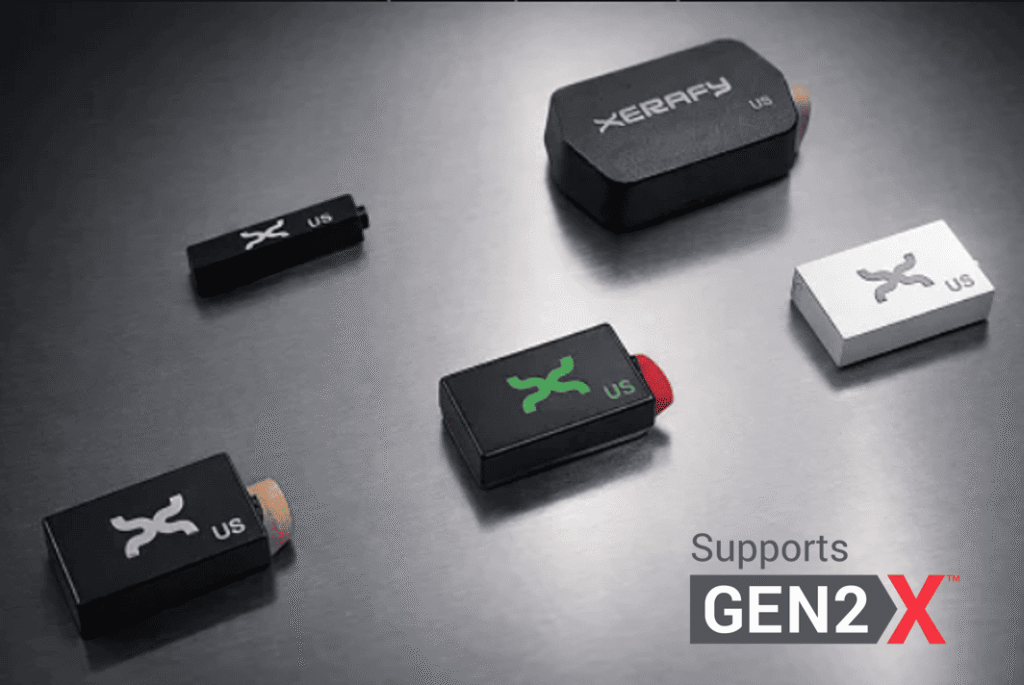
Compact on-metal tags can be attached to metal hand tools in protected, low-contact positions.
Miniature or embeddable tags can be considered for sockets and tools with limited mounting space or an approved recess.
Off-metal tags can be used on suitable plastic or composite tool surfaces.
Larger rugged tags can support equipment and tools requiring longer read distances or portal detection.
Attachment options include industrial adhesive, epoxy, heat-shrink tubing, mechanical fasteners and engineered recesses. Any modification to safety-critical, calibrated or warranted tools requires approval from the tool manufacturer or responsible engineer.
MRO Software and RFID for Automated Tool Control
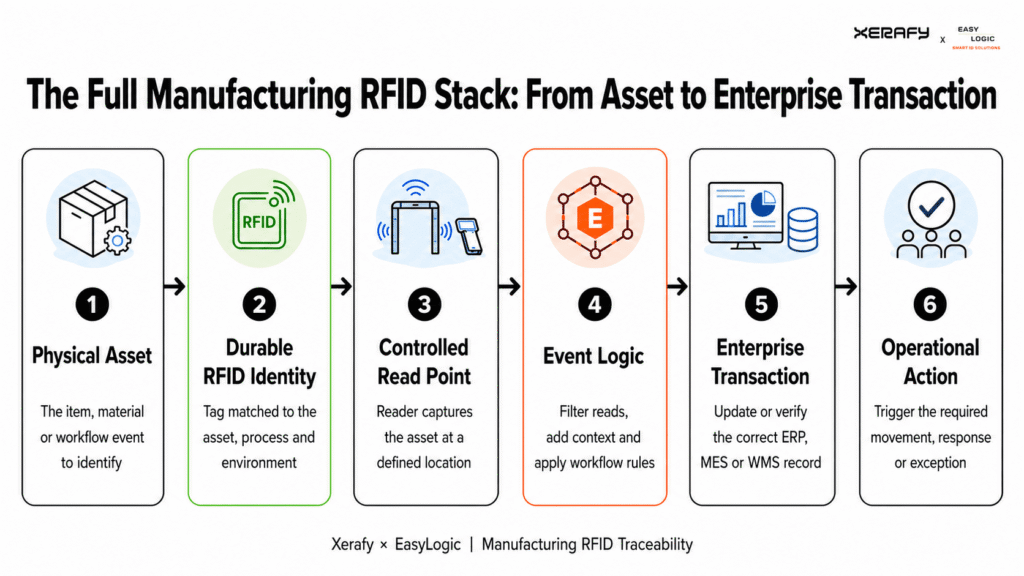
An automated tool-control system connects four distinct layers:
RFID tags provide a unique identity for each tool.
Readers and antennas detect tagged tools at handheld, cabinet, crib, trolley or portal read points.
RFID applications or middleware filter reads and convert them into presence, removal, return or movement events.
Tool-management, MRO, CMMS, EAM or ERP software connects those events to asset records, users, work orders and operating rules.
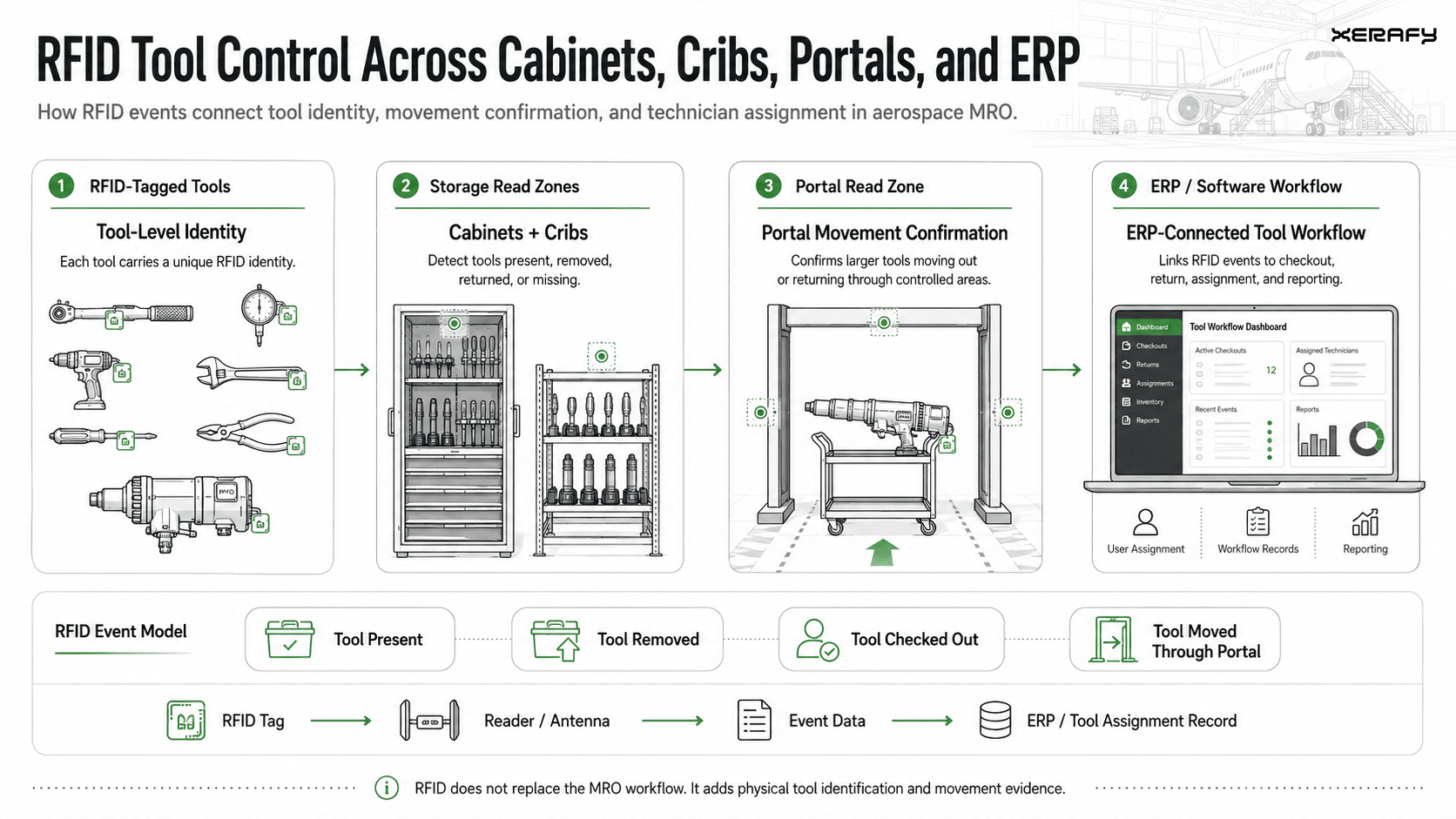
The detailed tool record normally remains in the software rather than on the RFID tag. Depending on the selected system and configuration, the software can manage:
Tool issue, return, transfer and custody
Current or last confirmed location
Cabinet, crib, trolley or kit inventory
Missing, overdue or unauthorized tools
Calibration and inspection status
Tool replacement and replenishment
User access and permissions
Audit trails, reports and enterprise-system integration
Available tool crib and tool-management software includes platforms such as CribMaster, Snap-on Level 5 and Nexess. Their supported hardware, workflows, integrations and continuity safeguards differ, so capabilities should be evaluated against the intended MRO process rather than treated as universal features.
Before selecting a system, define the system of record, required read events, user and tool identifiers, exception rules, integration method and expected behavior during network or power interruptions. The RFID design should then be validated with the selected software, readers, storage configuration and representative tagged tools.
How to Evaluate RFID Tool Control for Aviation FOD Programs
Begin with a representative tool population covering the smallest sockets, common metal hand tools, plastic or composite tools, calibrated items and larger equipment. Define where each category is stored, issued, returned and verified, then identify the read events required at cabinets, cribs, trolleys, portals or handheld inventory points.
Test candidate tags on the actual tools using the intended placement, attachment method, reader configuration and software workflow. Testing should include representative orientations, fully loaded storage conditions, expected handling and environmental exposure, missed or unintended reads, and the system response when a tool is removed, returned or remains unaccounted for.
Use the Xerafy MRO Test Pack to compare candidate tag configurations before committing to a pilot or deployment.
Xerafy develops field-proven RFID tags and labels for tracking assets in demanding industrial and enterprise environments. Its portfolio combines application-specific RFID engineering with products available for evaluation and deployment worldwide.
For requirements beyond standard products, Xerafy provides Custom RFID Tag services spanning printing, encoding, serialization and production configuration through to custom product engineering.