Email Xerafy in
Printed, marked, encoded, and engineered RFID solutions for industrial assets, products, and workflows
Service Bureau • Custom Engineering • EPC Encoding • OEM/ODM Support
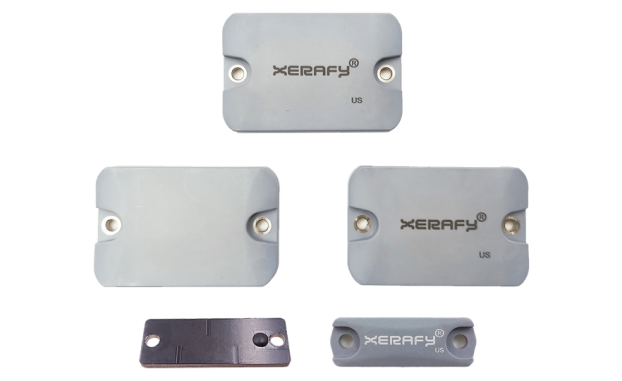
Use Xerafy Service Bureau when RFID tags or labels need to be prepared before deployment:
printed, marked, encoded, serialized, and supplied ready for project rollout

Create visible identification by printing asset numbers, SKUs, serial numbers, logos, text, barcodes, QR codes, or Data Matrix codes on RFID labels

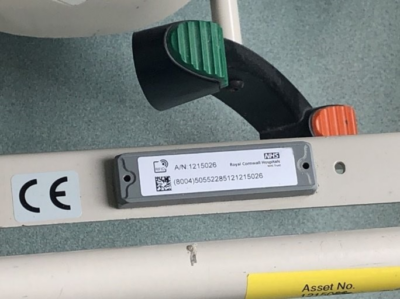
Create durable identification on RFID hard tags with marking methods selected for the tag material, application environment, and durability requirements, including thermal transfer printing, screen printing, and laser etching where applicable

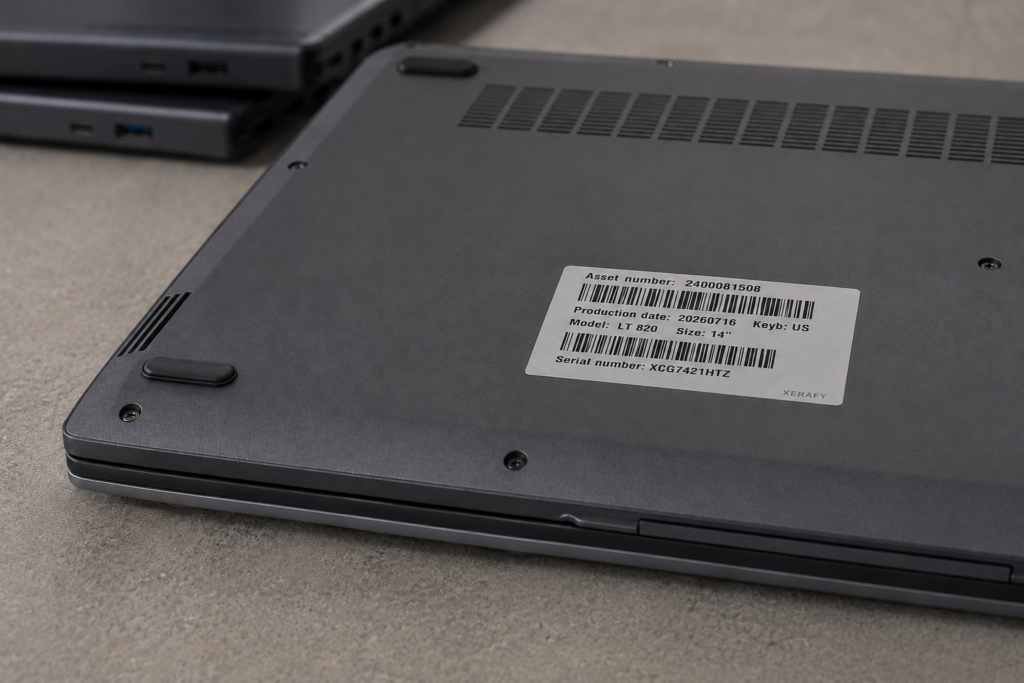
Create unique asset identities by encoding customer-specific serialized EPC values, applying password protection where supported, and matching each EPC to the printed ID, barcode, or QR code
Xerafy Service Bureau prints RFID labels with visible identifiers that support asset identification, operator handling, scanning workflows, and data reconciliation before deployment.
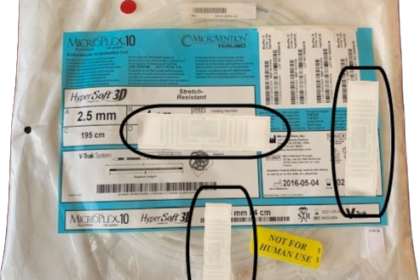
Printed elements can include asset numbers, SKUs, serial numbers, human-readable text, logos, 1D barcodes, QR codes, and Data Matrix codes.
RFID label printing is commonly used for UDI and medical-device labeling workflows, regulated product identification, retail or customer-mandated RFID labeling programs, industrial WIP labels, warehouse and inventory labels, returnable packaging labels, cold-chain items, and products that need both a visible identifier and an RFID identity.
Print asset numbers, SKUs, serial numbers, text, logos, and other visible fields that help operators identify and verify assets without an RFID reader.
Print 1D barcodes, QR codes, or Data Matrix codes to connect the RFID label with existing scanning, inventory, maintenance, healthcare, retail, or asset-management workflows.
For mandate-driven labeling projects, Xerafy can print customer-specified visible fields such as product identifiers, item references, serial numbers, SKUs, barcodes, QR codes, Data Matrix codes, logos, and human-readable text, depending on the selected RFID label and customer-supplied data structure.
Xerafy Service Bureau marks RFID hard tags with visible identifiers that support asset identification, operator handling, and field verification.
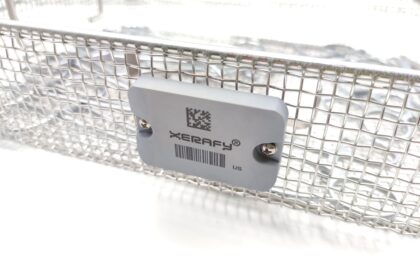
Marked elements can include asset numbers, serial numbers, human-readable text, logos, 1D barcodes, QR codes, and Data Matrix codes.
RFID hard tag marking is commonly used for asset tracking, tool inventory, tool-control systems, MRO equipment, returnable containers, pallets, racks, fixtures, industrial assets, outdoor equipment, and rugged environments where the visible identifier must remain readable through handling and use.
Mark asset numbers, serial numbers, logos, text, and other visible fields directly on RFID hard tags so operators can identify assets without relying only on RFID reads.
Select the marking method based on the tag material, housing, and application environment, including screen printing, laser etching, or other marking methods suited to abrasion, washdown, UV exposure, chemicals, outdoor use, oily workshops, and repeated handling.
For tool inventory and industrial asset tracking, marked RFID hard tags can carry asset numbers, serial numbers, logos, barcodes, QR codes, or Data Matrix codes directly on the tag body, helping operators identify assets even when an RFID reader is not being used.
Xerafy Service Bureau encodes RFID tags and labels with customer-specific EPC values before deployment, creating unique digital identities that can be read by RFID systems.
Serialized EPC values can be assigned from customer-defined ranges and matched to the printed ID, barcode, QR code, or Data Matrix code on each tag or label. Password protection and additional chip memory programming can be applied where supported by the selected RFID chip.
EPC encoding and serialization are commonly used for asset database matching, UID-based deployments, UDI and medical-device identification workflows, retail or customer-mandated RFID programs, inventory automation, WIP tracking, tool-control systems, returnable asset tracking, partner rollouts, and projects where each visible identifier must match a unique RFID identity.
For mandate-driven or system-integrated projects, Xerafy typically needs the customer’s EPC structure, serialization rules, SKU or item reference data, UID list, barcode or QR code structure, and any required matching file between visible identifiers and encoded RFID values.
Encode customer-specific EPC ranges to create unique RFID identities for assets, equipment, components, returnable items, products, or project batches.
Match each encoded EPC to the printed asset number, barcode, QR code, or Data Matrix code so the visible identifier and RFID identity remain aligned.
Apply password protection and program supported chip memory fields where required by the selected RFID tag, chip, and data structure.
To quote a Service Bureau project, Xerafy typically needs the selected RFID tag or label, quantity, artwork or logo file, visible ID fields, barcode or QR code requirements, EPC or UID list, serialization rules, batching requirements, and any application environment constraints.
For retail, UDI, or customer-mandated RFID programs, Xerafy also needs the applicable label layout, product or asset identifier fields, barcode or 2D code requirements, EPC or UID structure, serialization rules, quantity, and batching requirements.
Yes. Xerafy Service Bureau can prepare RFID labels and hard tags before deployment, depending on the selected product, marking method, encoding requirements, and project quantity.
Yes. Xerafy can match visible identifiers with encoded RFID data when customers provide the required ID list, EPC range, serialization rules, barcode or 2D code structure, and label or tag layout requirements.
Yes, in some projects. Printable RFID labels may be printed and encoded in the field using compatible RFID printers and workflows.
Xerafy Service Bureau is used when customers want tags or labels prepared before shipment, or when printing, encoding, serialization, and data matching need to be controlled before deployment.
If you plan to print labels in-house, compare Zebra RFID printers and download our practical setup guide.
Yes, where supported by the selected RFID chip. EPC memory, user memory, password protection, and lock options depend on the chip specification, tag model, and customer data structure.
Custom RFID Engineering is for customers and partners building RFID into a product, asset, or operating workflow, where RF performance, materials, attachment, asset identity data, durability, and production requirements need to be engineered together.
Xerafy routes each custom project through one of three proven RFID platforms: smart labels, on-metal labels, or hard tags. Each platform gives the project a validated technical foundation, while allowing the tag or label to be adapted to the asset surface, environment, read workflow, data structure, lifecycle, and manufacturing process.
This platform-based engineering approach supports OEM, ODM, converter, and solution-partner programs, as well as specialized RFID deployments across healthcare and medical devices, aerospace, oil and gas, supply chain and logistics, manufacturing, MRO, tool tracking, containers, and returnable assets.
Xerafy custom engineering combines proven RFID platforms with project-specific design, testing, and production development. This gives engineers the benefit of an established RFID foundation while still supporting specialized asset, product, environment, and connected-asset requirements.
Develop RFID smart labels for products, packaging, medical devices, healthcare workflows, specialty surfaces, regulated identification, customer-mandated labeling programs, and connected-asset applications.
Develop thin, printable RFID labels for metal assets, IT assets, industrial equipment, tools, components, containers, fixtures, and products that require RFID performance on metal surfaces.
Develop rugged RFID hard tags for industrial assets, tools, MRO equipment, containers, pallets, racks, outdoor equipment, returnable assets, and environments where durability, attachment, and read performance are critical.
Xerafy starts by identifying whether the project should be developed as a smart label, an on-metal label, or a hard tag:
> Smart labels are typically used for products, packaging, healthcare and medical-device workflows, UDI or customer-mandated labeling, specialty surfaces, and connected-asset applications.
> On-metal labels are used when the asset requires a thin, printable RFID label that performs on metal surfaces, including IT assets, industrial equipment, tools, components, fixtures, containers, and products that need source labeling or high-volume asset identification.
> Hard tags are used when the application requires a rugged RFID form factor for tools, MRO equipment, containers, pallets, racks, outdoor assets, returnables, or harsh industrial environments.
Xerafy translates the application into technical requirements before adapting the selected platform.
This includes asset type, surface material, available mounting area, read distance, reader setup, tag orientation, regional RAIN RFID frequency requirements, data structure, environmental exposure, deployment volume, production workflow, and expected lifecycle.
This step is critical for specialized applications such as medical-device labeling, aerospace asset tracking, oil and gas equipment identification, manufacturing WIP, tool inventory, returnable containers, logistics assets, and OEM product integration.
Define long-range, short-range, portal, handheld, dense-item, or controlled-zone read requirements
Define read reliability across tag angle, asset movement, stacking, placement, and reader setup
Optimize RFID performance on metal, plastic, glass, coated, curved, liquid-adjacent, or mixed-material assets
Specify EPC memory, user memory, passwords, serialization, UHF/NFC, sensing, or monitoring requirements
Adapt RAIN RFID performance for regional or global frequency bands, readers, printers, and systems
Balance size, thin profile, footprint, read range, durability, manufacturability, and available mounting space
Select attachment methods around installation time, permanence, serviceability, replacement risk, and total cost of ownership
Define resistance to impact, abrasion, washdown, UV, chemicals, oils, temperature, sterilization, and repeated handling
Xerafy engineers the RF architecture around the selected platform and the defined performance requirements.
This can include antenna design, chip selection, memory configuration, operating frequency, read range, reader compatibility, tag orientation, and performance on metal, plastic, glass, liquid-adjacent surfaces, or other application-specific materials.
For on-metal and multi-surface applications, antenna tuning and tag geometry are especially critical because the asset material can directly affect RF performance.
Xerafy engineers the physical construction so the RFID tag or label can survive the application while preserving RF performance.
Depending on the platform, this can include printable materials, face stocks, adhesives, overlays, laminates, polymers, PET, ceramics, PCB materials, silicone, encapsulation, housings, protective carriers, and packaging methods.
Attachment options can include industrial adhesives, screws, rivets, zip ties, welding, embedding, mechanical housings, or product-level integration. The correct method depends on the asset surface, mounting area, handling process, operating environment, and production workflow.
A custom RFID solution has to work in the customer’s system, in the field, and at production scale. Xerafy validates the tag or label against the identification workflow, field performance requirements, and deployment model.
Projects may require printed IDs, logos, barcodes, QR codes, Data Matrix codes, serialized EPC values, UID lists, UDI workflows, user memory, password protection, or matching files that connect printed identifiers with encoded RFID data.
For connected-asset programs, the RFID tag or label becomes the durable identity link between the physical item and its system records, lifecycle events, service history, inspection data, compliance records, or digital product information.
Xerafy can support prototype builds, RF testing, material and attachment review, marking and encoding checks, and environmental validation to confirm that the RFID solution performs in the intended workflow.
Validation may involve read range, reader setup, asset orientation, mounting method, surface material, handling process, operating environment, durability exposure, and real deployment constraints.
Once the design is validated, Xerafy can support manufacturability review, production format, quality requirements, supply planning, and scale-up for deployment.
For OEM, ODM, converter, and solution-partner programs, this can include product integration, source labeling, private-label requirements, embedded RFID identification, custom production formats, partner deployment files, and scalable supply for industrial or vertical programs.
To start an engineering review, Xerafy typically needs the asset type, surface material, available mounting area, operating environment, read workflow, reader setup, data and memory requirements, expected quantity, production process, and constraints around attachment, durability, temperature, sterilization, chemicals, branding, or product integration.
For OEM, ODM, product-integration, or confidential custom development projects, Xerafy can review requirements under NDA before detailed drawings, specifications, customer files, or proprietary process information are shared.
No. Many custom RFID projects start from a proven Xerafy platform — smart labels, on-metal labels, or hard tags — and are adapted to the asset, surface, environment, read workflow, data requirements, and production process.
A fully custom design may be considered when the requirement cannot be met through platform adaptation.
Yes. Xerafy can support OEMs, ODMs, converters, and solution partners with RFID integration, source labeling, private-label requirements, embedded RFID identification, custom production formats, partner deployment files, and scalable supply for industrial or vertical programs.
Label converters can also explore Xerafy’s specialty RFID platforms, converter-ready formats and project support.
Yes. Xerafy can review requirements involving metal surfaces, chemicals, oils, washdown, UV exposure, outdoor use, impact, abrasion, vibration, high or low temperature, sterilization, repeated handling, and other lifecycle constraints.
The final engineering path depends on the selected RFID platform, material stack, attachment method, RF performance target, and validation requirements.